
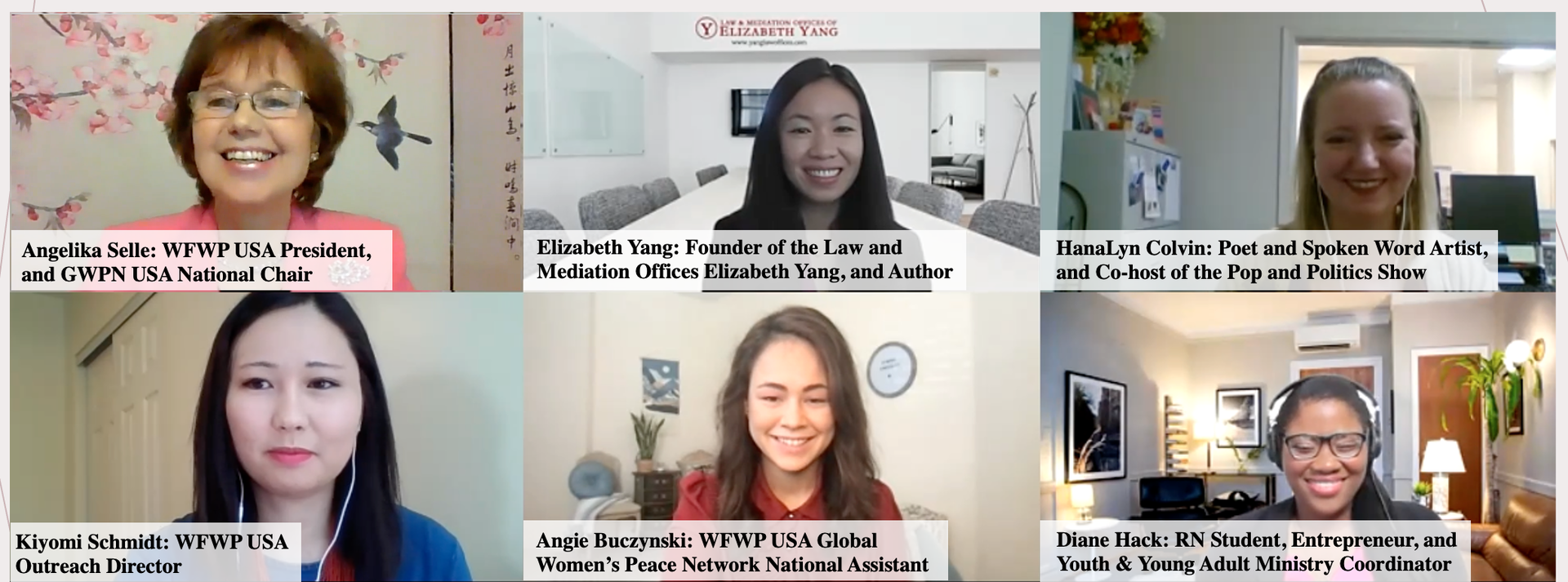
The Global Women’s Peace Network USA (GWPN), a project of Women’s Federation for World Peace, celebrated Women’s History Month with its second “Women’s Leadership in Reconciliation and Peacemaking” speakers forum. The theme and session content was centered on uplifting “The Next Generation” of women peace leaders. The forum featured two exceptional speakers from diverse backgrounds, a calligraphy performance, breakout sessions for reflection and networking, as well as commentary on the Mother of Peace memoir. The program took place on March 26, 2021, with over 81 attending the session live.
Angelika Selle, president of WFWP USA, and GWPN National Chair, moderated the program and introduced the session: “Women are needed now more than ever to bring changes to the table. We feel that in the peace culture we are trying to establish, we need a new type of leadership. A paradigm where the masculine and feminine are on equal footing, working together to harmonize, enhance each other’s strengths, and provide a place for the next generation to grow up in security and support.” She shared that during this special month we come together to “honor, recognize, and uplift the contributions women have made throughout history and for humanity”. Thus this event we turned to the next generation of young women to find out how they feel, how to contribute to peace, and better the environment.
Panelist Elizabeth Yang, Founder of the Law and Mediation Offices of Elizabeth Yang, and Author, began the session with her encouraging presentation entitled “Leadership from the Inside Out”. Sharing from her experiences as a mother and entrepreneur, she acknowledged the tough balancing act for women in having a family and a career. “As women, we are devoted to our families and to our children. [...] It’s difficult for us to put our careers first.” She started her own business to create a healthy work-life balance, and uses her business practices to change the culture of women feeling as though they need to have their careers secured before having a family. Elizabeth allows her employees to choose their own work hours and salary proportionally to give flexibility to all.
Elizabeth shared wisdom on the universal value of focusing on positivity, and how “energy flows where your focus goes.” Through vulnerably sharing her stories with her personal relationships, she emphasized the need for learning emotional intelligence, which is not taught in our education systems. She stressed the need to learn active communication, and how to resolve conflicts in the family and workplace through taking responsibility. Through her willingness to take responsibility and alter her actions and interpretations, she was able to reconcile and create peaceful relationships. Elizabeth concluded with empowering words saying “There is a positive action that you can take, and there is a negative option that you can take. [...] If you forgive someone and let it go, another door will open for you.”
HanaLyn Colvin, Poet and Spoken Word Artist, and Co-host of the Pop and Politics show, continued this engaging session speaking on the “Power of Art for Peace.” She shared from her heart and experiences of being able to use poetry as a way of building bridges and connecting with people. She addressed how in society there are many contentious issues, especially surrounding racial divisions. However, there is power in connecting through our shared experiences of suffering.
She spoke about her deep involvement in the spoken word scene, starting in New York, at the age of 19. Growing up in a predominately Caucasian culture, she was able to have profound experiences and learn through immersing herself with those of an African American background, ultimately having a bi-racial marriage with her late husband. She shared how “the message being pushed today in mainstream culture and politics is that this divide is insurmountable, and we cannot bridge it. [Poetry] is a basis for having empathy to see this other person, a fellow human being, brothers and sisters in God, and that there is more that connects us and unites us than divides us.”
HanaLyn emphasized using our suffering not to divide us, but as a “bridge between people as a way toward healing and towards reconciliation. A way of recognizing that the suffering is personal and intimate but at the same time universal.” During the question and answer session, HanaLyn shared a powerful sample of one of her poems about women. You can find it here.
Following those rich messages from our distinguished panel, participants enjoyed a video from Jiyoung Park, LA based calligrapher, and General Manager and Assistant to Director of the Korean Cultural Center, Los Angeles Consulate General of the Republic of Korea. Jiyoung created a special video in honor of Women’s History Month for this program. The video featured the painting of uplifting words on the faces of young women. Following the video, participants were moved into small breakout sessions to network and share their takeaways with each other.
Diane Hack, RN Student, Entrepreneur, and Youth and Young Adult Ministry Coordinator, concluded the event with a touching commentary on Mother of Peace, the memoir of WFWP Co-Founder Dr. Hak Ja Han Moon. From reading the memoir she learned that “the biggest thing is to know who you are and that is very powerful. [...] I think that her power comes from her ability to know who she is as God’s daughter.” She quoted the memoir: “When a child complains of a stomach ache, his mother lays him on her lap and rubs his tummy without a single word. Her hands may be gnarled and rough, but in a few moments the child feels better This may be a simple approach, but it is a practice based on love. We all dimly remember our mother’s warm touch. This is the very touch with which I long to embrace all of humankind as Mother of the universe and Mother of peace. As we know from our own experience, a mother hears her child’s cry very clearly and she has no thought but to quickly run to her child. This is because a mother’s love and attention are directed solely towards her children. A mother will walk through a fiery pit without hesitation to save her child.”
Participants expressed their gratitude with this powerful session and are looking forward to the rest of this GWPN series.
Reflections from participants:
“Hanalyn’s spoken-word message about peacemaking and reconciliation through connecting and understanding was inspiring because using pain as a tool to bring forth peace and unity can help heal so many hearts. [...] Elizabeth Yang’s discussion of emotional intelligence helped teach the importance of understanding and managing your own emotions in positive ways to relieve stress in your life and empathize with others to defuse conflict. Her story was beautiful because it taught the lesson that positivity and love always win. [...] Toward the end of the event, we had a few minutes to connect in break-out rooms with other people in attendance. This was a beautiful moment because this space allowed you to connect and discuss what stuck out the most and how we would implement what resonated in our lives. For me, the most significant takeaway was to always live life with a positive, loving heart with good towards others at the center because love, true selfless love, will help heal the world.”
-Laylah
“During these challenging periods, there was a discussion of common symptoms I was familiar with: suffering and exhaustion. I reflected on these symptoms and understood how they became byproducts of how we unconsciously choose to focus on the negativity of personal struggles throughout our journeys. [...] As a participant of the webinar, this specific piece of advice [from Elizabeth Yang] resonated with me because it reminded me that emotional intelligence becomes useful in any situation; Focusing energy towards solutions provides a peace of mind and gives you an ability to step out of the negativity. Speaker Hanalyn provided a similar solution for the removal of negativity during personal challenges. As HanaLyn described it, connections between people strengthens understanding and empathy during difficult times. While Hanalyn uses poetry to understand different individuals' struggles and establish connections, these interpersonal connections can be built in many ways. Through our bonds, we can develop a feminine sense of empathy and care for one another, making the transition to conflict resolution flow easier.”
-Carla